What is Trap Music?
In the early 2000s, a specific corner of Atlanta was producing a sound that had nothing to do with radio-friendly R&B or the polished hip-hop dominating MTV. It came from the trap houses — the drug spots that dotted neighborhoods like Bankhead, Zone 6, and Riverside. The music that grew out of those streets was bleak, cinematic, and relentlessly honest. It was trap. Trap music is a subgenre of hip-hop that originated in the American South in the late 1990s and crystallized into a distinct sound in Atlanta by the early 2000s. Its name comes directly from the trap house — slang for a place where drugs are sold. The genre is defined by its subject matter (street life, hustling, survival) and its signature sonic palette: booming 808 bass, rapid-fire hi-hat patterns, minor-key melodies, and a tempo that sits heavy and deliberate.
Origins: Atlanta, T.I., and the Trap Blueprint
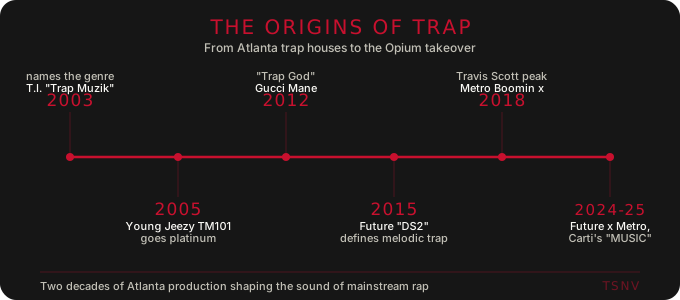
The foundational document of trap music is T.I.‘s 2003 album Trap Muzik. Released on Atlantic Records, it was the first major-label project to put the word trap in its title and to build an entire aesthetic around trap house life. T.I. rapped with the specificity of someone who had lived it — not performing poverty, but narrating it. The production, handled in part by Shawty Redd, leaned on programmed 808 drums, sparse hi-hats, and synthesized strings that gave the music a cinematic tension. Young Jeezy followed in 2005 with Let’s Get It: Thug Motivation 101, which pushed trap deeper into the mainstream. Jeezy’s delivery — a hoarse, motivational bark — became as influential as any production choice. Gucci Mane, who came up in the same Atlanta scene, added prolific output and a rawer street energy. Together, these three artists defined what trap sounded like, looked like, and talked about during its foundational era.
The Sound: 808s, Hi-Hats, and Dark Keys
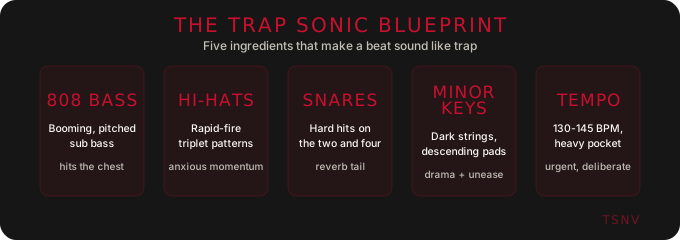
Trap’s sonic identity is immediately recognizable. The Roland TR-808 drum machine — a device from 1980 — became the genre’s backbone. Producers discovered that the 808’s bass drum could be pitched and elongated into a subsonic thud that hit differently on large speakers. That low-end rumble became non-negotiable. Above it, hi-hats were programmed in rapid triplet patterns — sometimes 16th notes, sometimes 32nds — creating a sense of anxious momentum. Snares hit hard on the two and four, often with a reverb tail that filled out the room. Melodically, trap favored minor keys and descending chord progressions. Synthesized strings, flutes, and piano loops created a sense of drama and unease that matched the lyrical content. Tempos typically fell between 130 and 145 BPM — fast enough to feel urgent, slow enough to feel heavy. Producers like Lex Luger, Zaytoven, and later Metro Boomin built careers on mastering and expanding this template.
Going Mainstream: The 2010s Expansion
By the early 2010s, trap had moved from a regional Atlanta sound to a national template. Drake incorporated trap production into his albums. Kanye West adopted 808-driven aesthetics. Even pop producers began borrowing the hi-hat patterns and bass profiles. The genre was no longer confined to street rap — it had become the default setting for commercial hip-hop. Future and Young Thug were central to this transformation. Future’s mixtape run from 2012 to 2014 introduced a heavily Auto-Tuned melodic trap approach — his voice became another instrument layered into the production rather than sitting on top of it. Young Thug took this further, treating cadence and melody with the freedom of a jazz improviser. Metro Boomin emerged as the defining producer of this era, his tag becoming one of the most recognized sounds in hip-hop.
Trap in the 2020s: Opium and the Rage Takeover
By the 2020s, trap was no longer a genre competing for space in hip-hop — it was the operating system running underneath almost all of it. The decade’s defining trap moment arrived in 2024, when Future and Metro Boomin released two collaborative albums weeks apart: We Don’t Trust You (March 22, 2024) and We Still Don’t Trust You (April 12, 2024). The first posted the biggest opening week of 2024, and its single Like That — featuring Kendrick Lamar — set off the year’s largest rap feud, proof that trap production still sat at the center of hip-hop’s biggest cultural events.
The other engine of 2020s trap was Opium, the label collective led by Playboi Carti. Its roster — Ken Carson, Destroy Lonely, and Homixide Gang — turned the rage offshoot into one of the dominant youth sounds in music. Ken Carson’s More Chaos (April 11, 2025) became his first Billboard 200 No. 1, while Carti’s own MUSIC (March 14, 2025) — a 30-track album that swapped his earlier baby-voice delivery for a raspier tone — became the era’s flashpoint and anchored his Antagonist Tour across late 2025.
Subgenres: How Trap Fractured Into Many Sounds
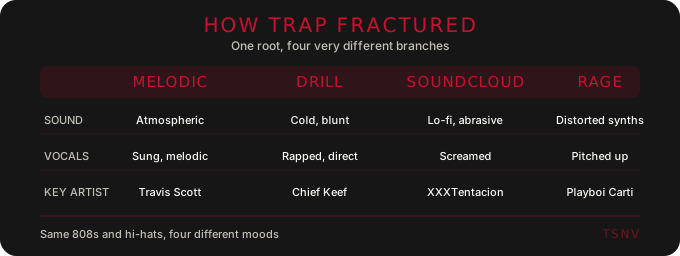
As trap spread geographically and stylistically, it spawned a set of distinct subgenres. Melodic trap — associated with artists like Travis Scott, Don Toliver, and Gunna — pushed the vocal melody and atmospheric production to the forefront. Scott’s Astroworld (2018) became the most commercially successful example of this direction, blending psychedelic textures with trap’s rhythmic core. Drill developed separately in Chicago around 2012, with Chief Keef and producer Young Chop creating a darker, more menacing variant. The tempo dropped, the energy turned colder, and the subject matter became even more direct. UK drill later emerged from London’s South and East, adding a grime-influenced cadence and making the style a global export. SoundCloud rap — associated with XXXTentacion, Lil Pump, and Ski Mask the Slump God — brought a lo-fi, chaotic energy to trap in the mid-2010s. The production was sometimes deliberately abrasive, and the vocals leaned into screaming and distortion. Rage, a more recent subgenre pioneered by Playboi Carti and producer Pi’erre Bourne, strips trap down to its most hyper and abstract — pitched-up vocals, distorted synths, minimal melody, maximum energy. By the mid-2020s, rage had grown into one of hip-hop’s dominant youth sounds, driven by Carti’s Opium collective — Ken Carson, Destroy Lonely, and Homixide Gang.
Trap Around the World
Trap’s migration beyond Atlanta accelerated through the 2010s as the internet dismantled regional barriers in music distribution. By the mid-2010s, artists on three continents were adapting the genre’s framework to their own languages, rhythms, and street realities. In the United Kingdom, drill took root in South London around 2012. Artists like Headie One and Dave took Chicago drill’s template and filtered it through British slang, Afro-Caribbean rhythms, and the specific anxieties of inner-city London. UK drill eventually fed back into the American market, influencing producers and rappers in New York and beyond. Latin trap emerged in Puerto Rico and New York in the early 2010s, blending trap’s production style with reggaeton’s DNA. Bad Bunny and Anuel AA became its two biggest global exports. Bad Bunny’s ability to move between trap minimalism and full pop production without losing credibility made him one of the most-streamed artists in the world across multiple years. Afro-trap developed in France, driven largely by artists from West African immigrant communities in Paris and Lyon. MHD, often credited as the originator, fused trap’s 808s and hi-hats with Afrobeats percussion and Afro-Caribbean melodies. The result was a sonically distinct hybrid that spread across Francophone Africa and into broader European hip-hop.
Essential Trap Albums
- T.I. — Trap Muzik (2003): The genre’s founding document. It put a name to the sound and a face to the aesthetic before either had mainstream vocabulary.
- Young Jeezy — Let’s Get It: Thug Motivation 101 (2005): The album that took trap from a regional curiosity to a platinum-selling commercial force, with Jeezy’s voice as its most distinctive instrument.
- Gucci Mane — Trap God (2012): A mixtape that distilled the original Atlanta trap sound to its purest form, arriving just as the genre was being diluted by mainstream adoption.
- Future — DS2 (2015): The record that defined melodic trap as a full artistic statement, not just an aesthetic choice. Future’s pain and ambivalence ran through every Auto-Tuned note.
- Metro Boomin — Not All Heroes Wear Capes (2018): The producer’s debut album doubled as a definitive statement of what Atlanta trap production sounded like at its peak — dark, cinematic, and precisely constructed.
- Travis Scott — Astroworld (2018): Trap at its most psychedelic and maximalist. Scott used the genre’s rhythmic structure as scaffolding for something closer to a theme park ride than a rap album.
- Roddy Ricch — Please Excuse Me for Being Antisocial (2019): A snapshot of trap at the moment it fully absorbed melodic R&B, generating one of the longest-running No. 1 singles in chart history with The Box.
- Playboi Carti — Whole Lotta Red (2020): Polarizing on release, it became a cult reference point for the rage subgenre — trap reduced to primal energy, with conventional lyricism almost entirely abandoned.
- Future & Metro Boomin — We Don’t Trust You (2024): The album that reasserted classic Atlanta trap at full commercial scale, posting the biggest opening week of the year and setting off hip-hop’s defining feud through its single Like That.
- Playboi Carti — MUSIC (2025): A sprawling 30-track statement that pushed rage into the mainstream and became one of the most-streamed rap albums of the decade so far.
Frequently asked questions
Who invented trap music?
No single artist invented trap music — it emerged from a community of producers and rappers in Atlanta in the late 1990s and early 2000s. T.I. is most frequently credited with defining and naming the genre through his 2003 album Trap Muzik, while producers like Shawty Redd and later Lex Luger and Zaytoven built the sonic language.
Is Drake trap?
Drake is not a trap artist in the traditional sense, but he has been one of the genre’s most influential borrowers. From Take Care onward, he consistently incorporated trap production — 808s, hi-hats, Metro Boomin beats — into his albums while maintaining a melodic, introspective lyrical approach that is more R&B than street rap.
What is the difference between trap and drill?
Trap and drill share the same foundational production elements — 808 bass, hi-hat patterns, minor keys — but differ in tone, tempo, and geography. Trap, as it developed in Atlanta, encompasses a range of moods from boastful to reflective. Drill, which originated in Chicago around 2012 and later mutated in London, is specifically darker and more aggressive in both production and lyrical content.
What is rage music?
Rage is a high-energy offshoot of trap pioneered by Playboi Carti and producer Pi’erre Bourne in the late 2010s. It strips the genre down to distorted synths, pitched-up vocals, heavy 808s, and minimal melody, prioritizing raw energy over lyricism. By the mid-2020s it had become one of the dominant youth sounds in hip-hop, led by Carti’s Opium collective, including Ken Carson and Destroy Lonely.
Why is it called trap?
The name comes from the trap house — street slang for a location where drugs are sold. The term itself comes from the idea of being trapped in a cycle of poverty and illegal activity with no clear exit. Early trap artists used the name both to describe their environment and to signal authenticity about where the music was coming from.
Is trap music still popular?
Trap is not just still popular — it is the dominant structural framework of mainstream hip-hop and has been for over a decade. Its grip only tightened in the 2020s: Future and Metro Boomin’s 2024 albums posted the year’s biggest opening week, and Playboi Carti’s Opium label pushed the rage offshoot to the top of the charts. The 808 bass and hi-hat triplets that defined early Atlanta trap are now standard components of pop, R&B, and country production alike.