What is Jersey Club?
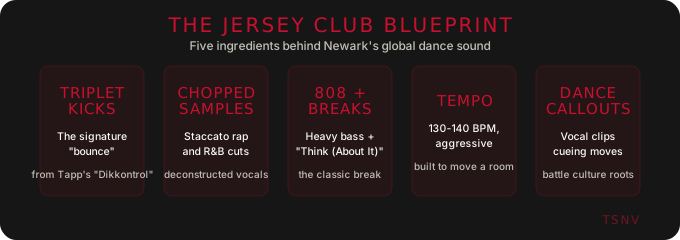
Jersey club (originally called Brick City club) is a style of electronic club music that originated in Newark, New Jersey, in the late 1990s and early 2000s. Built on a fast, “bouncy” groove near 130 to 140 BPM, heavy triplet kick patterns, and chopped rap and R&B samples, it grew out of Baltimore club’s hybrid of house and hip-hop before developing its own distinctive, more aggressive palette. Jersey club is inseparable from dance: it is almost always accompanied by frenetic, competitive dances that have spread globally through viral video, and its bitcrushed offshoot krushclub now links it directly to the internet-rap underground.
Origins: The Brick Bandits and Brick City Club
Newark had a club music scene through the 1990s built on Chicago house, but the sound sharpened after 1999, when Baltimore house records like Tapp’s “Shake Dat Ass” and “Dikkontrol” reached the city through DJs including Nix In The Mix and Mustafah. DJ Tameil, already known for his Chicago house mixtapes, connected with the Baltimore scene and began playing its records at Newark teen parties. In 2001, Tameil released his own club tracks with the Dat Butt EP on his label Anthrax Records; a week later, DJs Tim Dolla and Mike V began releasing their own tracks as the Brick Bandits, initially feuding with Tameil before he joined the crew. In 2002, Tameil coined the phrase “Brick City club”, referencing Newark’s nickname. Around 2005, as the sound spread beyond Newark via Myspace and college campuses, the genre’s name shifted to “Jersey club,” with a younger generation of producers — Nadus, DJ Sliink, Jayhood, and R3LL — pushing the style forward.
By 2008, Jersey club was getting airplay on major stations like Hot 97 and Power 105, and Newark’s Unicorn151 collaborated with Baltimore’s DJ K-Swift on “Tote It Remix” — the first track built around rapping over a club beat. That same period, Philadelphia began developing its own club scene directly influenced by the Jersey sound. The scene increasingly centered on competitive dance battling, inspired by DJ Fresh’s viral “Get Silly,” alongside Tim Dolla’s “Swing Dat” and Jayhood’s “Patty Cake.” By 2009, the sound had spread to 21-and-over clubs and new audiences well beyond its Newark teen-party roots, and the rapping-over-club-beats approach pioneered by Unicorn151 eventually solidified into its own fusion genre, Jersey club rap, which continues to feed producers well outside New Jersey.
The Sound: Triplet Kicks, Chopped Vocals, and 808 Bass
Jersey club’s defining feature is its “bouncy” groove, driven by big kick-drum triplets and heavy tresillo or shuffled kick patterns — a signature often traced to Tapp’s “Dikkontrol.” Producers layer in staccato, chopped samples pulled from rap and R&B tracks, along with 808 bass and sampled breakbeats, most famously from Lyn Collins’ “Think (About It).” Brick Bandits member Dirty South Joe described the process as chopping and fragmenting vocals, layering them over heavy bass kicks “to deconstruct the source material, and rework it for the dance floor.” Billboard once summed up the sound as landing “somewhere between New York’s vogue and Chicago’s juke with a little bit of that nasty from Miami bass.” Producers historically leaned on accessible tools to build it — Sony Acid Pro and FL Studio remain the genre’s most common programs — and that low barrier to entry is part of why Jersey club spread so quickly through a self-released, CD-and-Myspace distribution network rather than through labels.
Jersey Club’s Newest Branch: Krushclub
Jersey club’s most recent crossover runs straight into the internet-rap underground. Krushclub, a subgenre of sigilkore that emerged in the early 2020s, fuses Jersey club’s triplet-kick groove with bitcrushed electronic production. It was pioneered by sigilkore artist Luci4 with the track “Kurxxed Emeraldz,” and the term itself was coined by artist Lumi Athena to describe the mashup of Jersey club and bitcrushing effects. It is one more sign of how a two-decade-old Newark dance sound keeps finding new, unexpected homes in internet rap’s fastest-moving corners.
Frequently asked questions
Where did Jersey club come from?
Jersey club originated in Newark, New Jersey, in the late 1990s and early 2000s, pioneered by DJ Tameil, Mike V, DJ Black Mic, and DJ Tim Dolla of the Brick Bandits crew, who were inspired by Baltimore club’s uptempo fusion of house and hip-hop.
What does Jersey club sound like?
Jersey club is built on a fast, bouncy groove around 130 to 140 BPM, driven by heavy triplet kick drum patterns, staccato chopped rap and R&B samples, 808 bass, and sampled breakbeats such as Lyn Collins’ Think (About It).
Why was it originally called Brick City club?
Newark’s nickname is Brick City, and DJ Tameil coined the phrase Brick City club in 2002. The name shifted to Jersey club around 2005 as the sound spread beyond Newark to college campuses and a wider audience via Myspace.
What is the connection between Jersey club and krushclub?
Krushclub is a subgenre of sigilkore from the early 2020s that fuses Jersey club’s triplet-kick groove with bitcrushed electronic production. It was pioneered by sigilkore artist Luci4 and named by artist Lumi Athena.
Is Jersey club just dance music?
Jersey club is deeply tied to competitive, frenetic dance culture, but it also produced the fusion genre Jersey club rap and continues to influence production far outside dance music, most recently through its bitcrushed krushclub offshoot.