What is Digicore?
Digicore is the Discord-and-Minecraft-born internet microgenre where teenage producers turned heavy autotune, trap 808s, and nightcore-pitched vocals into one of the most distinct sounds to come out of underground rap. It developed alongside hyperpop in the late 2010s to early 2020s in the United States, originally known as “draincore” before the modern name took hold. Digicore sits at the crossroads of cloud rap, emo rap, and hyperpop, and it shares a producer-and-Discord-server origin story with its close cousin sigilkore.
Origins: From Draincore to Digicore
Digicore began in the late 2010s as “draincore,” a style of online rap inspired by Drain Gang (Bladee, Ecco2k, Thaiboy Digital, and producer Whitearmor) and 100 gecs. In 2018, a scene figure known as Dalton started a Minecraft and Discord server called “Loser’s Club,” which became a hub for artists including Quinn, Kmoe, Glaive, Ericdoa, and Midwxst. The early scene also centered on SoundCloud collectives like Blackwinterwells’ Helix Tears and Prblm’s Novagang. By 2019, artist lonelee — founder of the label teardrop digital, with Quinn as its first signed artist — coined the term “digicore” to replace “draincore.” In 2021, curator Billie Bugara’s SoundCloud playlist of the same name further popularized it. Artists Yungster Jack and David Shawty are credited as pioneers; music outlet BrooklynVegan called the pair “responsible for the SoundCloud scene’s transition from emo rap to hyperpop.”
Pioneering artists were typically 15 to 18 years old at the microgenre’s inception, building tracks through Discord servers, Minecraft, YouTube beat tutorials, and a cracked copy of FL Studio. Digicore artist d0llywood1 summarized the scene bluntly: “We’re all digital kids who met each other on the internet and so make music that sounds like shit we found on the internet.” Other notable names include Jane Remover, Aldn, quannnic, Lucy Bedroque, Slayr, Kuru, Lieu, and brakence. The scene has also been closely associated with LGBTQ culture, with several key artists identifying as gay, non-binary, or transgender, and the genre’s heavy vocal modulation giving artists room to experiment with gender presentation.
The Sound: Autotune, 808s, and Layered Melody
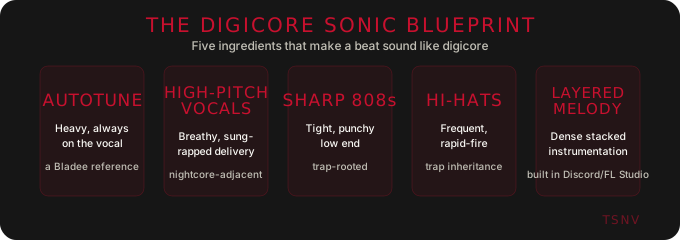
Digicore is defined by heavy autotune, layered melodies and instrumentation, high-pitched, breathy vocals, sing-rapping, sharp 808s, and frequent hi-hats. The autotune-forward vocal approach traces directly to Bladee, which music journalist Kieran Press-Reynolds called a “central reference” for the genre. Digicore also draws from nightcore’s pitched-up aesthetic. Writer Billie Bugara noted that digicore artists “pull from genres as wide-reaching as midwestern emo, trance, and even Chicago drill,” along with Jersey club and Brazilian funk. Critically, digicore is distinguished from its parent genre hyperpop mainly by its trap-based foundation. As NPR critic Sheldon Pearce put it in 2025: “Digicore is hyperpop, but hyperpop isn’t necessarily digicore.”
Digicore and the Rage Connection
As digicore matured through 2024 and 2025, its sound increasingly absorbed influence from rage artists like Playboi Carti and Yeat — a sign of how tightly the internet-rap microgenre ecosystem is wound together. Digicore, rage, and sigilkore now regularly trade producers, aesthetics, and fanbases, even though each traces back to a different corner of the same cloud-rap family tree.
The word “digicore” itself is a portmanteau of “digital” and “-core,” a suffix borrowed from hardcore punk that had already appeared in the 2000s as shorthand for “digital hardcore.” In the late 2010s, an online community of teenage musicians on Discord revived the term to distinguish themselves from the pre-existing hyperpop scene, though the labels “robloxcore,” “glitchcore,” and “hyperpop” were all initially used more or less interchangeably with digicore before the naming settled. That terminological mess is part of the genre’s story: writer Billie Bugara has defined digicore as simply “not Hyperpop and not Glitchcore,” a definition by elimination that reflects how blurry the boundaries between these internet-native scenes really are.
Frequently asked questions
What is digicore music?
Digicore is an internet microgenre of hip-hop and electronic music that developed alongside hyperpop in the late 2010s to early 2020s. It is characterized by heavy autotune, high-pitched breathy vocals, sharp 808s, frequent hi-hats, and layered, densely produced melodies, built mostly by teenage producers on Discord and SoundCloud.
Who started digicore?
Digicore began as draincore, inspired by Drain Gang and 100 gecs in the late 2010s. Artist lonelee coined the term digicore in 2019 to replace draincore, and Yungster Jack and David Shawty are credited as pioneers of the sound.
What is the difference between digicore and hyperpop?
Digicore is closely tied to hyperpop but leans more heavily on trap-based influences. NPR critic Sheldon Pearce summarized it in 2025: digicore is hyperpop, but hyperpop is not necessarily digicore.
Is digicore connected to Playboi Carti or rage?
Yes. Through 2024 and 2025, digicore increasingly absorbed influence from rage artists like Playboi Carti and Yeat, reflecting how closely digicore, rage, and sigilkore are now linked within the broader internet rap scene.
Who are the key digicore artists?
Notable digicore artists include Jane Remover, quannnic, brakence, Glaive, Ericdoa, midwxst, Aldn, and the genre’s credited pioneers, Yungster Jack and David Shawty.