What is Emo Rap?
Emo rap (also called emo hip hop or sad rap) is the subgenre that fused trap-style beats with sung vocals and the emotional openness of emo, pop punk, and indie rock. It emerged in the early 2010s through the SoundCloud rap scene and a wing of cloud rap, and by the late 2010s it was one of the most commercially dominant sounds in hip-hop. Where mainstream rap traditionally leaned on bravado, emo rap leaned into depression, anxiety, heartbreak, and self-medication — described by The Wall Street Journal as artists “giving their elders the finger.”
Origins: GothBoiClique and the SoundCloud Underground
The term “emo rap” itself predates the 2010s scene by years. Atmosphere rapper Slug claimed in 2017 that he had coined the phrase as far back as a 1997 magazine interview, and critics occasionally applied it earlier still to artists like Eminem, Kanye West, and Drake for their emotionally direct writing, long before it described a coherent sound. German rapper Casper was tagged “emo rap” early in his career for blending hip hop with post-hardcore bands, and Huffington Post used the label for Hollywood Undead in 2012 — all scattered, informal uses that predate the genre as it exists today.
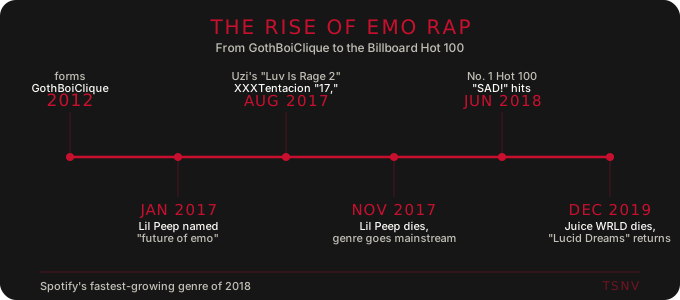
Emo rap’s earliest pioneers include Black Kray‘s Goth Money Records, Bones — whose VHS-recorded videos and dark aesthetic earned him the nickname “underground rap king” from Dazed — and the members of GothBoiClique, founded in 2012 by a subgroup of Raider Klan with the explicit goal of connecting emo, trap, dark wave, black metal, and indie rock. GothBoiClique members Wicca Phase Springs Eternal, Lil Tracy, and Lil Peep would go on to shape the genre’s mainstream sound. In January 2017, Pitchfork branded Lil Peep the “future of emo,” and that August, XXXTentacion’s debut album 17 and Lil Uzi Vert’s Luv Is Rage 2 both charted high on the Billboard 200 — moments critics consider defining for emo rap’s arrival in the mainstream. That same month, Lil Uzi Vert’s “XO Tour Llif3” peaked at No. 7 on the Billboard Hot 100.
2017-2019: Three Deaths, and a Genre’s Hardest Years
Emo rap’s mainstream rise was shadowed by tragedy. In November 2017, Lil Peep died of a fentanyl overdose at 21; his debut album Come Over When You’re Sober, Pt. 1 and single “Awful Things” charted on Billboard shortly after, and his death brought the genre significant new attention. In June 2018, XXXTentacion was murdered at 20; his albums 17 and ? both re-charted the following week, and his song “SAD!” reached No. 1 on the Billboard Hot 100. A posthumous Lil Peep and XXXTentacion collaboration, “Falling Down,” was certified platinum in the US that September. Emo rap was Spotify’s fastest-growing genre in 2018. In December 2019, Juice WRLD died at 21 after a seizure induced by an overdose; his song “Lucid Dreams,” which had peaked at No. 2 on the Hot 100 in 2018, returned to the chart at No. 8 following his death.
The Sound and the 2020s Pop-Punk Revival
Emo rap combines elements of conscious hip hop with indie rock instrumentals, frequently sampling 2000s pop punk and emo songs from bands like Mineral, Underoath, and the Postal Service. Fans are sometimes called “sad boys,” after Yung Lean’s collective of the same name. In the early 2020s, artists including 24kGoldn, the Kid Laroi, Powfu, and Iann Dior signed major deals off the back of the sound — Powfu and Beabadoobee’s “Death Bed (Coffee for Your Head)” hit No. 1 on the US Hot Rock/Alternative Songs chart in February 2020, and 24kGoldn and Iann Dior’s “Mood” went quadruple platinum that July. Forbes called 2020 “the year rap artists rule the rock charts.” The genre’s DNA also runs through rage and digicore, and it sparked a broader 2020s pop-punk revival, with Machine Gun Kelly’s Tickets to My Downfall singled out for bridging the two scenes.
Frequently asked questions
Who started emo rap?
Emo rap’s earliest pioneers include Black Kray’s Goth Money Records, Bones, and GothBoiClique members Wicca Phase Springs Eternal, Lil Tracy, and Lil Peep. It was popularized in the mainstream by Lil Peep, Trippie Redd, uicideboy, XXXTentacion, and Juice WRLD.
What is emo rap about?
Emo rap lyrics typically focus on depression, loneliness, anxiety, drug and alcohol use, nihilism, heartbreak, and self-medication, described by The Wall Street Journal as rappers giving their elders the finger with unusually open emotional content.
Why did emo rap break into the mainstream in 2017?
August 2017 saw XXXTentacion’s debut album 17 and Lil Uzi Vert’s Luv Is Rage 2 both chart high on the Billboard 200, while Lil Peep had already been branded the future of emo by Pitchfork that January. Emo rap became Spotify’s fastest-growing genre the following year.
What happened to Lil Peep, XXXTentacion, and Juice WRLD?
All three central emo rap artists died between late 2017 and late 2019: Lil Peep of a fentanyl overdose in November 2017, XXXTentacion by murder in June 2018, and Juice WRLD from a seizure induced by an overdose in December 2019. Each death brought renewed mainstream attention and chart activity to the genre.
What genres did emo rap influence?
Emo rap fed directly into digicore, hyperpop, and rage, and it sparked the broader 2020s pop-punk revival, with rappers like 24kGoldn, the Kid Laroi, and Machine Gun Kelly carrying its melodic, emotionally direct approach into mainstream rock and pop charts.