What Is Drill Music? The Complete Guide to Hip-Hop’s Most Confrontational Subgenre
Drill music announced itself to the world in 2012, when a teenager from Chicago’s South Side named Keith Cozart — known as Chief Keef — uploaded a song called “I Don’t Like” to YouTube from inside a juvenile detention facility. The beat was slow, cold, and mechanical. The subject matter was direct. Within weeks it had millions of plays. That recording did not invent the genre, but it made ignoring it impossible.
Drill music is a subgenre of trap defined by its tempo (typically 60–75 BPM), its relentlessly dark minor-key production, and lyrical content drawn directly from the street-level realities of high-crime urban neighborhoods. The name is believed to derive from Chicago slang — to “drill” means to shoot. The music was never meant to be anything other than what it was: a document of a specific place and a specific moment.
Since then, drill has traveled from the South Side to South London, from Brooklyn to Brussels, becoming one of hip-hop’s most globally adopted and locally adapted subgenres. This guide covers every major variant, the key artists and producers who built each scene, and where the genre stands today.
Origins: Chicago’s South Side, 2012
Drill’s founding scene coalesced in neighborhoods like Englewood, Woodlawn, and South Shore on Chicago’s South Side. The key producer was Young Chop, whose beats stripped trap’s template down to its coldest essentials — slower tempo, near-empty space between hits, hi-hats that felt like a countdown rather than a pulse. Other producers central to the early Chicago sound included DJ L and Smylez, each contributing to the genre’s brooding, atmospheric identity.
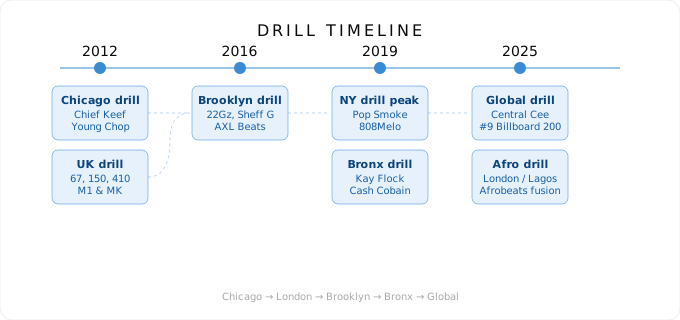
Chief Keef’s 2012 mixtape Finally Rich and the major-label album of the same name defined the aesthetic: flat, almost emotionless delivery, explicit descriptions of violence, and a visual universe of ski masks and block corners that became the genre’s iconography. Lil Durk, G Herbo, Lil Bibby, King Louie, and Fredo Santana emerged from the same scene, each taking the template in different directions.
Durk in particular would prove pivotal. Where Keef’s delivery was deliberately flat, Lil Durk introduced melodic elements to drill — singing hooks over the same cold production, blending vulnerability with street narrative. His 2013 mixtape Signed to the Streets became one of the most influential drill releases and anticipated the melodic direction that would dominate the genre’s second wave.
The Sound: What Makes Drill Different From Trap
The comparison between drill and trap is inevitable because drill grew directly out of trap’s production framework — both use 808 bass, hi-hats, and minor-key melodies. But the differences are significant and worth mapping out in detail.
| Element | Drill | Trap |
| Tempo | 60–75 BPM (half-time feel) | 130–145 BPM |
| Tone | Dark, cold, confrontational | Ranges from dark to celebratory |
| Melody | Sparse; negative space as feature | Layered synths, atmospheric pads |
| Lyrical focus | Street reportage, specific conflicts | Broader: wealth, lifestyle, emotion |
| Vocal style | Flat, emotionless, direct | Melodic hooks, Auto-Tune, singing |
| Key producer | Young Chop, 808Melo | Metro Boomin, Southside |
| Key artist | Chief Keef, Pop Smoke | Future, Travis Scott |
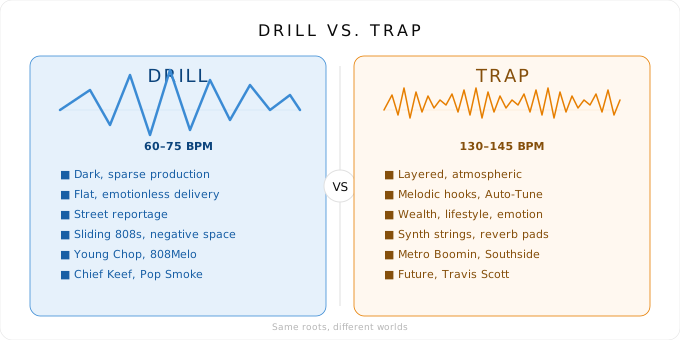
Where trap’s tempo typically sits between 130 and 145 BPM, drill slows to 60–75 BPM — the rhythmic equivalent of a half-time feel that makes every bar feel heavier. The melodic content is darker and more sparse; where melodic trap producers like Metro Boomin layer synthesized strings and atmospheric pads, drill producers often leave negative space as a deliberate choice. The emptiness is part of the message.
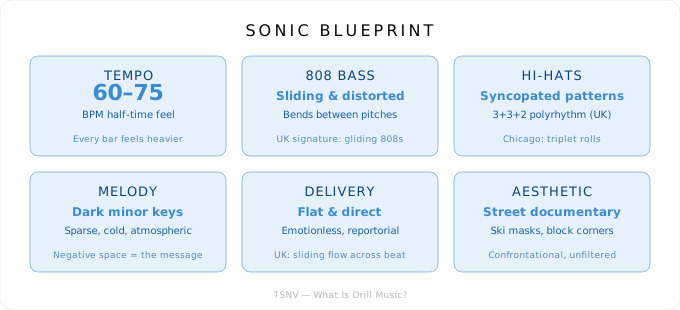
Production differences extend beyond tempo. Chicago drill’s hi-hats use triplet patterns that create an urgent, mechanical pulse. UK drill shifted these to a syncopated 3+3+2 polyrhythm influenced by grime and UK garage, while Brooklyn drill combined both approaches with heavier, more distorted 808 bass. The sliding 808 — a bass note that bends downward or upward between pitches — became particularly associated with UK and NY drill production.
The Producers Who Built Drill
Drill’s identity has always been defined as much by its producers as its rappers. Understanding the genre requires knowing who built each regional sound.
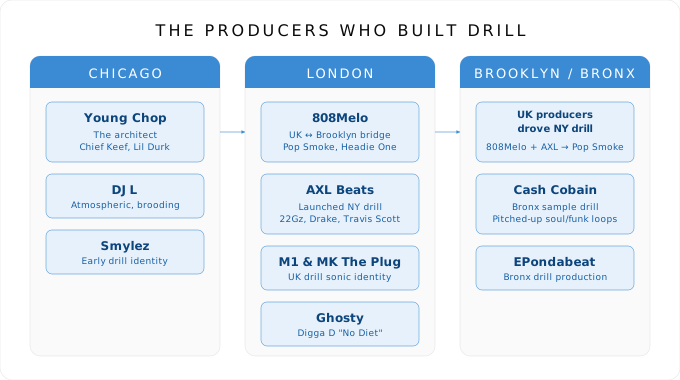
- Young Chop (Chicago) — The architect. His beats for Chief Keef, Lil Durk, and Lil Reese established the original template: minimal melodic content, heavy kick drums, dark minor-key chord progressions, and a deliberate emptiness that gave drill its signature tension. He identified Shawty Redd, Drumma Boy, and Zaytoven as important precursors to the sound.
- 808Melo (London/Brooklyn) — An East London producer who became the bridge between UK and NY drill. He produced Pop Smoke’s Meet the Woo mixtape and the hit “Welcome to the Party,” which went platinum. His sliding 808 patterns and crisp percussion defined both Headie One’s UK material and Pop Smoke’s Brooklyn debut. He is credited as a pioneer of three subgenres simultaneously: UK drill, Brooklyn drill, and the transatlantic crossover.
- AXL Beats (London) — Produced the earliest Brooklyn drill tracks, including 22Gz’s “Suburban” (2016) and Sheff G’s “No Suburban” (2017), both of which are credited with launching the NY drill movement. Also produced Drake’s “War” and Travis Scott’s “GATTI” with Pop Smoke, bringing UK drill production to mainstream American audiences.
- M1 On The Beat & MK The Plug (London) — A production duo whose chunky garage bass and twitching drum patterns helped UK drill develop its own sonic identity distinct from Chicago. Their collaborative work became a blueprint for dozens of UK producers who followed.
- Ghosty (London) — Known for producing Digga D’s viral hit “No Diet” and numerous UK drill tracks. Part of the wave of London producers whose YouTube instrumentals were discovered by Brooklyn rappers, facilitating the transatlantic exchange.
UK Drill: London Rewrites the Template
Around 2012, a parallel scene emerged in South London — initially in areas like Brixton, Peckham, and Stockwell — that took Chicago drill’s production framework and rebuilt it around a distinctly British experience. UK drill became its own distinct form within two or three years, drawing influence from earlier British genres like grime and UK garage. As grime MC Jammer noted, “without grime, there would be no UK drill.”
Early UK drill groups — 67, 150, Harlem Spartans, 410, 1011 — established the sound and culture. The most identifiable difference from Chicago is rhythmic. UK drill rappers developed a “sliding” flow style that cuts across the beat rather than landing squarely on it, influenced by Afro-Caribbean speech patterns and grime’s rhythmic DNA. The vocabulary, slang, and references are specifically British.
The genre’s commercial breakthrough came with Headie One’s Edna (2020), which debuted at number one on the UK Albums Chart — the first UK drill album to achieve that milestone. Dave’s We’re All Alone in This Together (2021) pushed the genre’s lyrical possibilities further, using drill production as a canvas for extended literary storytelling.
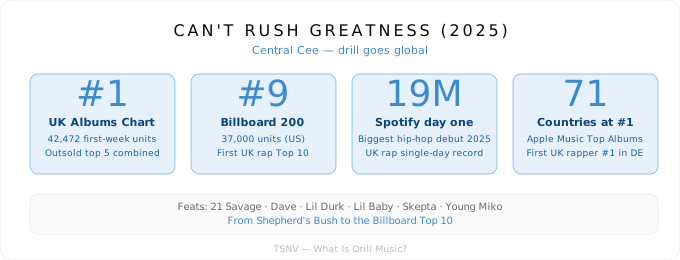
By 2025, UK drill’s most commercially successful figure is Central Cee. His debut album Can’t Rush Greatness debuted at number one on the UK Albums Chart and number nine on the Billboard 200 — the first UK rap album to reach the American Top 10. The album earned over 19 million Spotify streams on its first day, breaking the record for any UK rap release. Central Cee’s success represents drill’s transformation from underground subgenre to global commercial force, with chart positions in over 70 countries.
NY Drill: Brooklyn, the Bronx, and the Pop Smoke Legacy
UK drill eventually fed back into the United States through a route that surprised everyone. 22Gz and Sheff G were among the first Brooklyn rappers to use UK drill beats, both working with London-based producer AXL Beats as early as 2016. But it was Pop Smoke who crystallized the sound into something unmistakable.
Pop Smoke discovered 808Melo’s YouTube instrumentals and built his entire sonic identity around UK drill production married to a deep, commanding Brooklyn vocal style. His 2019 mixtape Meet the Woo became the key document of the crossover moment. “Welcome to the Party” went platinum and received remixes from Nicki Minaj and Skepta. His posthumous album Shoot for the Stars Aim for the Moon (2020) debuted at number one on the Billboard 200 and became one of the year’s best-selling rap albums.
Pop Smoke was murdered in February 2020 at age 20. His death left a void that dozens of Brooklyn and Bronx rappers have attempted to fill. Fivio Foreign carried the torch most directly, working with the same UK producers. Lola Brooke demonstrated that drill could support a wider range of vocal approaches. Ice Spice translated Bronx drill’s energy into pop-adjacent viral hits.
Bronx drill emerged as its own variant in the early 2020s, distinguished by its use of sample drill — pitched-up soul, funk, and pop samples layered over drill drums and sliding 808s. Producers like Cash Cobain and EPondabeat drove this innovation. Artists including Kay Flock, B-Lovee, and DThang built followings through TikTok virality, with recognizable samples increasing the music’s shareability.
Key Artists: The Drill Roster
Understanding drill requires knowing the artists who defined each regional variant. This is not a comprehensive list — it is a map of the figures whose work shaped the genre’s trajectory.
Chicago
- Chief Keef — The genre’s most visible founding figure. “I Don’t Like” and Finally Rich established the sonic and visual template for drill globally. His influence extends far beyond the genre — mumble rap, SoundCloud rap, and even rage owe debts to his approach.
- Lil Durk — Chicago drill’s most commercially successful artist and one of hip-hop’s biggest names. His melodic approach to drill expanded the genre’s emotional range. Founded the Only the Family (OTF) collective, which included the late King Von. As of early 2026, Durk is in federal custody awaiting trial on murder-for-hire charges stemming from a 2022 shooting. His album Deep Thoughts, released during his incarceration in March 2025, underscored the paradox at drill’s center: art that documents real violence, made by artists entangled in its consequences.
- G Herbo — The most emotionally honest voice in Chicago drill. Humble Beast (2017) dealt with grief and PTSD in a genre that rarely allowed space for either.
- King Von — A master storyteller whose murder in 2020 triggered the chain of retaliation at the center of Durk’s federal case. His music represented drill’s narrative potential — cinematic, detailed, and unflinching.
London / UK
- Headie One — UK drill’s most consistent voice. Albums like Edna (2020) and GANG brought the genre into the British mainstream and attracted collaborations with Fred Again.. and Drake.
- Dave — A lyricist whose drill-based production serves as a vehicle for literary storytelling. We’re All Alone in This Together (2021) proved that drill could be intellectually ambitious without losing its edge.
- Central Cee — UK drill’s global crossover star. Can’t Rush Greatness (2025) broke every commercial record for a UK rap release: #1 in 71 countries on Apple Music, #9 on the Billboard 200, and 19 million Spotify streams on day one. His ability to move between drill, pop, and Afrobeats-inflected material has made him the genre’s most versatile commercial artist.
- Digga D, Unknown T, Nemzzz — Part of the wider UK drill ecosystem that continues to produce new voices. Unknown T’s “Homerton B” (2018) was the first UK drill single to chart on the Official Singles Chart.
New York
- Pop Smoke — The bridge between UK production and New York vocal delivery. His death at 20 cut short what was already one of hip-hop’s most impactful debut runs.
- Fivio Foreign — Pop Smoke’s closest sonic heir, continuing to work with UK producers including 808Melo and AXL Beats.
- Ice Spice — Translated Bronx drill energy into pop-crossover viral hits, demonstrating the genre’s range beyond its original aesthetic.
- Sheff G and 22Gz — Brooklyn drill’s earliest adopters, both working with UK producers before the sound had a name in New York.
Drill Goes Global
By the mid-2020s, drill has become a genuinely global production language. The genre’s adaptability — its rhythmic framework, 808 bass palette, and dark melodic vocabulary — has allowed it to be localized in ways few other hip-hop subgenres have achieved.
| Subgenre | Origin | Key Artist | Defining Sound |
| Chicago drill | Chicago, 2012 | Chief Keef | Dark keys, slow tempo, raw delivery |
| UK drill | London, 2012 | Headie One | Sliding 808s, syncopated hi-hats, Afro-Caribbean flow |
| Brooklyn drill | Brooklyn, 2016 | Pop Smoke | UK production + NY vocal aggression |
| Bronx drill | Bronx, 2020s | Kay Flock | Sample-based, pitched-up soul/funk loops |
| Afro drill | London/Lagos, 2020s | Central Cee | Afrobeats + drill fusion, global pop crossover |
Afro drill emerged primarily in London’s diaspora communities, blending drill’s percussion with Afrobeats melodies and vocal cadences. Central Cee’s music frequently operates in this hybrid space. The sound has also taken root in Lagos, Accra, and Paris, where local rappers have adapted drill’s framework to their own linguistic and musical traditions.
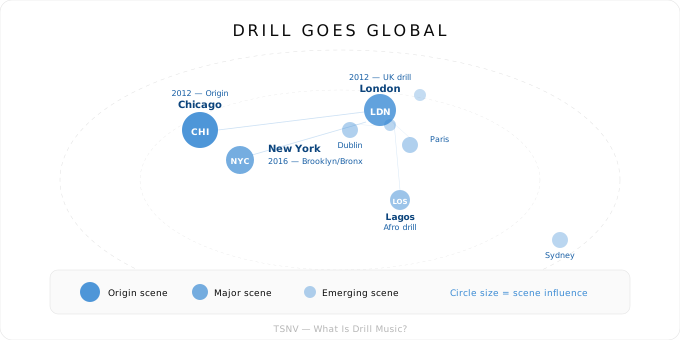
Parallel drill scenes have emerged in Ireland (with Dublin developing a particularly active scene), Australia, France, the Netherlands, and across Scandinavia. Each localizes drill’s production template while adding region-specific slang, flow patterns, and cultural references. UK drill’s influence on global English slang — spreading Multicultural London English to cities from Helsinki to Melbourne — has been documented by linguists as one of the genre’s most unexpected cultural impacts.
Mainstream American hip-hop has absorbed drill in diluted form. Drake has repeatedly incorporated UK drill aesthetics, from his Link Up TV “Behind Barz” freestyle (2018) to AXL Beats-produced tracks like “War.” Travis Scott collaborated with Pop Smoke on “GATTI” (2019), produced by 808Melo and AXL Beats. Kanye West’s Donda (2021) featured drill-influenced production. These crossover moments brought drill’s sonic vocabulary to audiences who might never encounter the genre’s underground origins.
The Controversy: Lyrics, Law, and Censorship
No hip-hop subgenre has faced more sustained legal and political pressure than drill. The genre’s relationship with real-world violence — both as subject matter and, in some cases, as context — has made it a target for law enforcement on both sides of the Atlantic.
In Chicago, prosecutors began using drill lyrics and music videos as evidence in criminal cases as early as 2014. The argument was that drill content constituted admissions of criminal activity. Defense attorneys and civil liberties advocates countered that this standard was not applied to other genres depicting violence — country music, heavy metal, and mainstream film all depict violence without their creators facing prosecution for it.
In London, the Metropolitan Police’s Operation Domain specifically targeted drill music videos, requesting that YouTube remove hundreds of them on the grounds that they incited violence. Several UK drill artists have been subject to Criminal Behaviour Orders (CBOs) that restricted their ability to make music, enter certain postcodes, or even use specific words in recordings. Artists including Digga D and Skengdo & AM were prosecuted or restricted under these measures.
The debate intensified with Lil Durk’s federal case. Prosecutors have attempted to use his lyrics as evidence of a murder-for-hire conspiracy, while his defense team argues that the government misidentified the timing of recordings and presented misleading evidence to a grand jury. Regardless of the outcome, the case represents the highest-profile test of whether drill lyrics can be used as criminal evidence in federal court.
Critics of these prosecutorial approaches point to a double standard: drill is targeted because of who makes it and where it comes from, not because of what it depicts. Advocates argue that criminalizing music creates a chilling effect on artistic expression in communities that already face disproportionate policing.
Essential Drill Albums
| Artist | Project | Year | Notes |
| Chief Keef | Finally Rich | 2012 | The genre’s commercial debut. Raw, cold, structurally unlike anything in mainstream hip-hop. |
| Lil Durk | Signed to the Streets | 2013 | Melodic drill’s founding document. Durk’s vulnerability set him apart from the scene. |
| G Herbo | Humble Beast | 2017 | Grief, trauma, and survival rendered without sentiment. Chicago drill’s second wave. |
| Pop Smoke | Meet the Woo | 2019 | The key crossover document. UK production meets Brooklyn vocal delivery. |
| Headie One | Edna | 2020 | First UK drill album to debut at #1 on the UK Albums Chart. |
| Pop Smoke | Shoot for the Stars Aim for the Moon | 2020 | Posthumous. #1 Billboard 200. Defined NY drill’s commercial ceiling. |
| Dave | We’re All Alone in This Together | 2021 | UK drill as literary fiction. Extended storytelling, lyrical density. |
| Lil Durk | Deep Thoughts | 2025 | Released during federal incarceration. Street realism under the most extreme circumstances. |
| Central Cee | Can’t Rush Greatness | 2025 | #1 UK, #9 Billboard 200. First UK rapper in US Top 10. 19M Spotify streams day one. |