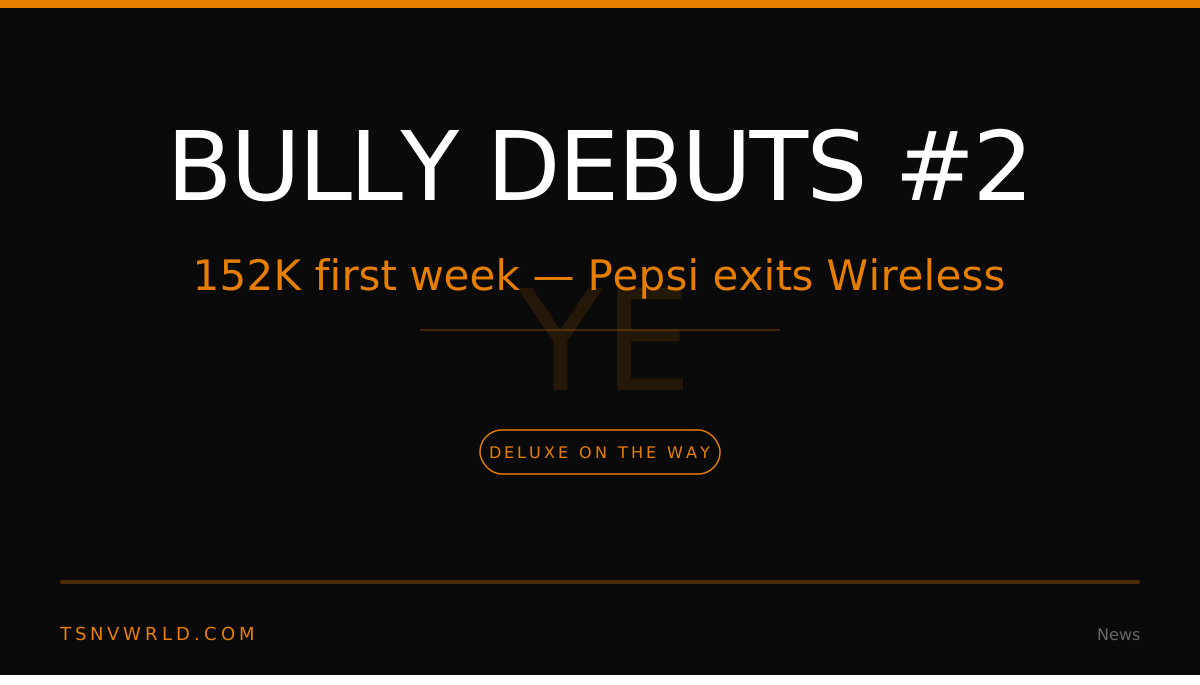
Kanye West’s twelfth studio album Bully debuted at No. 2 on the Billboard 200 chart dated April 6, 2026, earning 152,000 equivalent album units in its first tracking week ending April 2. Of that total, 96,000 units came from streaming — equal to 98.43 million on-demand official streams — while 56,000 units came from pure album sales. The remaining units were derived from track-equivalent album calculations. The result makes Bully the biggest hip-hop streaming debut of 2026 so far, but also marks the first time a Kanye West solo album has failed to debut at No. 1 since The College Dropout peaked at No. 2 in 2004.
The album was blocked from the top spot by BTS’s Arirang, which held steady at No. 1 for a second consecutive week with 187,000 equivalent album units, down 71% from its opening-week total of 641,000. Arirang has now spent the longest period atop the chart of any BTS album, with each of the group’s six previous No. 1 entries lasting a single week at the summit.
Meanwhile, Ye’s Wireless Festival booking in London has triggered a political firestorm. U.K. Prime Minister Keir Starmer publicly condemned the three-night headline engagement, prompting Pepsi to withdraw its decade-long title sponsorship of the festival within hours. Diageo, parent company of Johnnie Walker and Captain Morgan, followed with its own withdrawal. The fallout adds a volatile layer to what was already one of the most debated album rollouts in recent memory.
First Week by the Numbers: Streaming Strength, Sales Debate
Bully was released on March 28, 2026, through Ye’s YZY imprint and the multimedia company Gamma, co-founded by former Apple executive Larry Jackson. The album arrived on streaming platforms on a Saturday rather than the industry-standard Friday, a scheduling choice that would become a key point of contention in the days following its release.
According to Billboard’s tracking data provided by Luminate, the album’s 152,000 equivalent units broke down as follows: streaming accounted for the lion’s share at 96,000 units, pure album sales contributed 56,000, and the remainder came from track-equivalent calculations. Billboard noted that first-week sales were boosted by multiple colored vinyl variants, deluxe boxed sets bundled with branded merchandise, and signed editions made available through Ye’s website and at his SoFi Stadium concerts.
Independent music data platform Chart Data initially reported that Bully accumulated 33.2 million Spotify streams during its partial first day of availability. Gamma contested that figure almost immediately, claiming the album actually reached close to 50 million streams in its first full day on Spotify. Gamma described the number as positioning Bully firmly as the largest hip-hop streaming debut of the year.
By press time, Bully had amassed approximately 264 million global Spotify streams. The album also reached No. 1 on both Apple Music and Spotify’s global charts, according to promotional materials shared by Gamma on Instagram.
Despite the streaming performance, the 152,000-unit first week represents Ye’s lowest solo debut in his career. For comparison, Vultures 1 — his 2024 collaborative album with Ty Dolla $ign — opened at No. 1 with 148,000 units, while Vultures 2 debuted at No. 2 with 107,000 units. His 2021 solo album Donda opened with 309,000 units. Donda 2, his last solo full-length before Bully, was deemed ineligible for the Billboard 200 due to its initial release being exclusive to the Stem Player platform.
Gamma Fires Back: The Case for 201K and a No. 1 Debut
Ye’s distributor did not accept Billboard’s numbers quietly. On Sunday, April 5, Gamma took to Instagram Stories to counter the official first-week tally, claiming that Bully actually moved approximately 201,000 equivalent units in its first full seven days of availability.
The dispute centers on timing. Because Bully arrived on streaming services on Saturday, March 28, rather than Friday, March 27, Gamma argued that the Billboard tracking window — which runs Friday through Thursday — captured only six days of the album’s first week rather than a full seven. The distributor’s own count includes sales from Ye’s second SoFi Stadium show on April 3, late uploads to Apple Music, and updated product sales and streaming data beyond what Luminate reported through its standard Friday cutoff.
“The real deal. A big week for independent artists,” Gamma captioned its Story post, which also highlighted the “FATHER” music video featuring Travis Scott as the No. 1 trending video on YouTube, the album’s global streaming numbers, and Ye’s claim to the highest-grossing single concert in SoFi Stadium history.
Billboard has not publicly responded to Gamma’s counter-claims. The chart methodology has long relied on Luminate’s tracking week, and no exception has been made for non-standard release dates. Whether the discrepancy affects perception more than it affects the official record remains an open question, but the debate has given fans on both sides plenty of ammunition.
Bully Deluxe Announced — No Release Date Given
Alongside its first-week sales pushback, Gamma also announced that a deluxe edition of Bully is in the works. The announcement arrived without a release date, tracklist additions, or any indication of what the expanded version might include.
The lack of specifics has been met with skepticism by some listeners and industry observers. Ye has a well-documented history of delaying projects — Bully itself was originally scheduled for June 15, 2025, before being pushed repeatedly through July, August, November, December, January, and finally landing on March 28, 2026. Many fans have also expressed the view that the album feels unfinished in its current form, with criticisms directed at vocal quality and mixing rather than production, which has been widely praised.
Bully features 20 tracks with guest appearances from Travis Scott, André Troutman, CeeLo Green, Don Toliver, and Peso Pluma. Production credits include Ye himself, Troutman, the Legendary Traxster, 88-Keys, James Blake, and Havoc of Mobb Deep. The album’s lead single, “Father” featuring Travis Scott, was produced in part by Havoc and has drawn particular praise from critics. Billboard ranked it the fifth-best track on the album, with Rolling Stone’s Preezy Brown offering the same placement and comparing the Ye-Travis chemistry to that of “Otis,” their celebrated 2011 collaboration with Jay-Z.
Critically, Bully has received a polarized reception. Pitchfork gave the album a 3.4 out of 10, calling it “a cheap hit of retro-Kanye.” Vice took a contrasting view, describing it as Ye’s “most coherent, satisfying project in years.” The Financial Times offered a negative review that framed its criticism through the lens of Ye’s January 2026 Wall Street Journal apology for his antisemitic statements. Fan reception has been similarly divided, with defenders pointing to the production quality and detractors questioning the vocal performances.
SoFi Stadium: Two Sold-Out Nights and a Revenue Record
Bully’s release week was anchored by two sold-out concerts at SoFi Stadium in Inglewood, California — Ye’s first Los Angeles performances in roughly five years. The first show took place on April 1, 2026, and the second on April 3.
The shows featured a mix of Bully material and career-spanning hits. Travis Scott appeared as a guest at both concerts, performing alongside Ye on “Father” and other tracks. The second night also brought out Lauryn Hill, who joined Ye for performances of “All Falls Down” — which samples her 2002 live track “Mystery of Iniquity” — and a rendition of “Doo Wop (That Thing)” that transitioned into Ye’s “Believe What I Say,” itself a song built on a sample of Hill’s original. CeeLo Green and Ye’s eldest daughter, North West, also appeared on stage during the second show.
Gamma claimed the SoFi run set the venue’s all-time grossing record for a single concert, though independent verification of that claim has not been published. The first show was not without incident — Ye stopped mid-performance of “Good Life” to call out the production team’s lighting choices, describing the disco-style effects as “corny” and instructing the crew to restart the song.
The concerts served a dual commercial purpose. In addition to generating ticket and merchandise revenue, album sales at the venue contributed to Bully’s first-week totals. Gamma specifically cited sales from the April 3 show as part of its argument for higher overall numbers.
Pepsi and Diageo Pull Wireless Festival Sponsorship
While Bully’s chart performance dominated the U.S. conversation, Ye’s international touring plans created a separate crisis across the Atlantic. On Saturday, April 5, the Wireless Festival in London announced that Ye would headline all three nights of the event, scheduled for July 10–12, 2026, at Finsbury Park. The booking was billed as Ye’s first U.K. performance in 11 years — his last London festival headline was Wireless 2014 (and Glastonbury 2015).
The response from British political leaders was immediate and forceful. Prime Minister Keir Starmer issued a statement to The Sun calling the booking “deeply concerning” given Ye’s past antisemitic statements. Starmer added that antisemitism “in any form is abhorrent and must be confronted clearly and firmly wherever it appears.”
The Jewish Leadership Council called the booking “deeply irresponsible,” citing Ye’s repeated use of his platform to promote antisemitic and pro-Nazi messaging. Liberal Democrat leaders called for Ye to be banned from entering the country entirely. The Mayor of London distanced the city government from the festival, stating that Ye’s past comments were “offensive and wrong.”
Hours after Starmer’s statement, Pepsi announced it was withdrawing its sponsorship. The company had served as the festival’s headline partner since 2015, with the event officially branded as “Pepsi MAX Presents Wireless.” A Pepsi spokesperson confirmed the decision in a brief statement without naming Ye directly.
Diageo followed on Sunday evening. A spokesperson for the drinks conglomerate — which owns Johnnie Walker, Captain Morgan, and other brands — said: “We have informed the organisers of our concerns and as it stands, Diageo will not sponsor the 2026 Wireless festival.”
As of Monday morning, the Wireless Festival website still displayed Pepsi branding and continued to advertise Ye’s three-night headline booking. Festival organizers — Festival Republic, a division of Live Nation — have not commented publicly on the sponsor withdrawals or the political backlash. Tickets are scheduled to go on sale Tuesday.
The festival website also lists additional partners including PayPal, Rockstar Energy Drink, Budweiser, Beatbox, and Big Green Coach. None of these companies had publicly stated a position on the booking at the time of publication.
The Broader Context: Apology, Album, and the Question of Redemption
The Wireless controversy does not exist in a vacuum. In January 2026, Ye published a full-page apology in The Wall Street Journal, addressing both the Black and Jewish communities for his past behavior. He attributed some of his actions to a prolonged manic episode linked to his bipolar disorder. The apology was widely covered but met with mixed reactions — some viewed it as a genuine step toward accountability, while others saw it as a strategic move ahead of the Bully rollout and his return to touring.
Rolling Stone reported that Bully had finished recording before the apology was published, complicating the narrative that the album represents a post-reckoning creative statement. The album itself contains no direct references to the controversy, focusing instead on themes of self-reflection, faith, and lifestyle.
Ye’s 2026 world tour in support of Bully extends well beyond London. Confirmed dates include shows in India (May 23), Turkey (May 30), the Netherlands (June 6 and 8), France (June 11), Italy (July 18), Spain (July 30), and Portugal (August 7). Whether additional sponsor pullouts or political interventions affect any of these dates remains to be seen.
The commercial performance of Bully — strong by most standards but historically weak by Ye’s own — will likely fuel both sides of the ongoing debate about his place in modern culture. For supporters, 152,000 units as an independent release with no traditional label marketing represents resilience. For critics, the absence of a No. 1 debut and the mounting institutional pushback suggest a career operating under fundamentally different conditions than the one that produced 21 consecutive Grammy-winning years.
Travis Scott and the Road Ahead
Travis Scott’s presence on “Father” and at the SoFi Stadium shows marks the latest chapter in a relationship that has weathered its own turbulence. In February 2025, Ye publicly criticized Scott during a series of posts on X, accusing him of removing Ye’s contributions from Utopia — specifically the handling of the track “Telekinesis,” where Ye alleged Scott replaced him with Future without discussion. Scott unfollowed Ye on Instagram in response.
The reconciliation began in November 2025, when Scott brought Ye out as a surprise guest during a concert in Tokyo. By February 2026, producer Havoc revealed in a Complex interview that the two were actively working on a collaborative project, with several Havoc-produced tracks already making the cut. In the same month, both artists were announced as co-headliners for Italy’s Hellwatt Festival on July 17–18.
Scott is also working on his own fifth solo studio album, his first since Utopia in July 2023. In a January 2026 Rolling Stone cover story, he described the project as designed for stadium-scale performance and hinted at an immersive, large-format sonic approach. Industry sources have indicated Scott has been in active recording sessions since January 2026, though no title or release date has been confirmed.
For now, Bully’s first week is in the books. The deluxe edition looms without a date. The Wireless Festival controversy is escalating. And the numbers — whether you trust Billboard’s 152K or Gamma’s 201K — confirm that Ye remains one of the most commercially viable artists in hip-hop, even as the ground beneath him continues to shift.



Leave a Reply